A flashcard becomes a recall exercise when you try to answer before revealing its other side. Looking at both sides first tests familiarity instead. The difference is easy to miss when you are tired or moving quickly through a set.
Here is a short exercise you can try with Spanish numbers. It also works with words collected from a book, lesson or conversation.
Try it with one word
Look at diez. Before turning the card, say its meaning aloud. Then reveal the answer and check whether you actually produced “ten.” If you recognised the answer only after seeing it, treat that as a word that still needs practice.
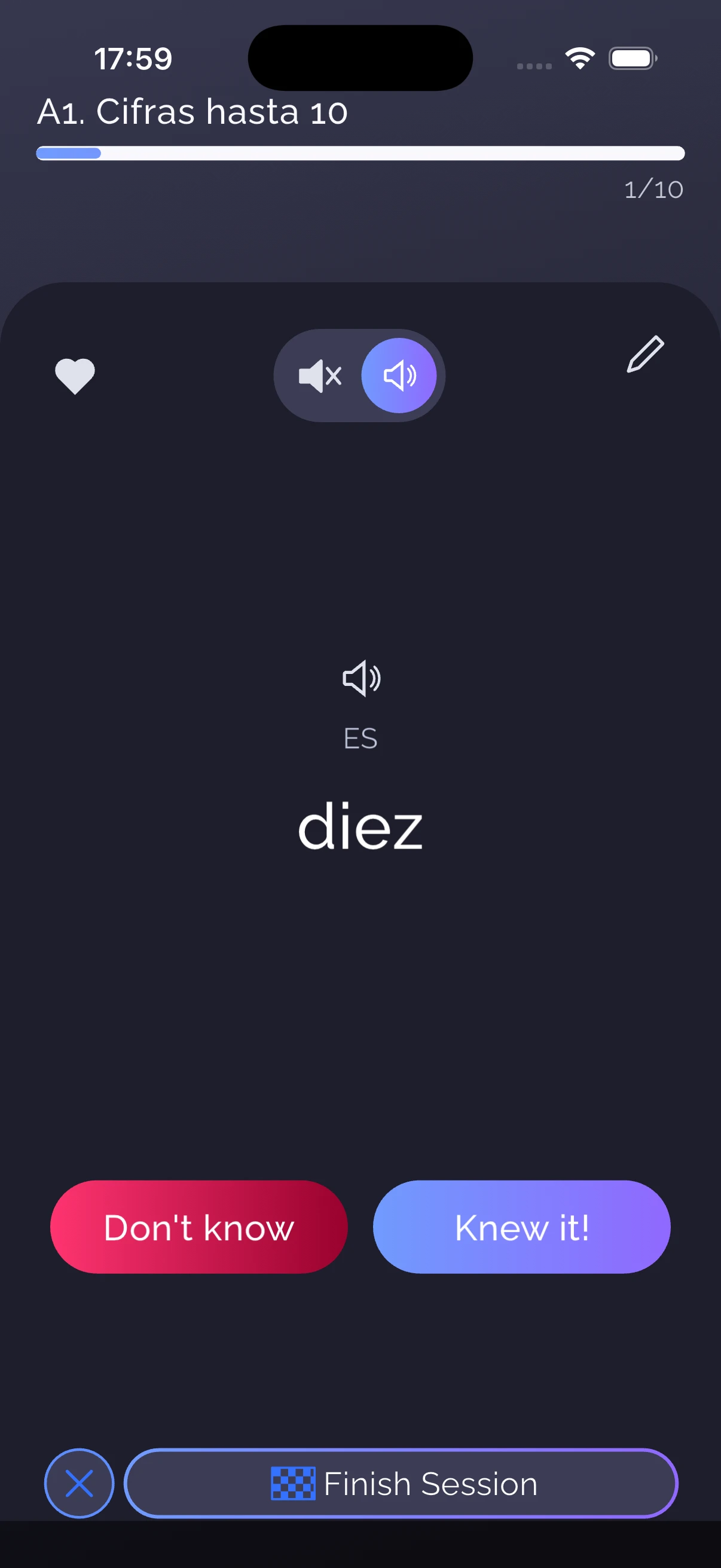
Now reverse the task: start with ten and produce diez. These are different skills. The first helps you understand something you read; the second helps you find a word when speaking. If your goal is conversation, include practice in both directions.
Build prompts you can mark honestly
| Prompt | Problem | Better version |
|---|---|---|
| “bank” | Several meanings are possible | “The bank beside the river” |
| A paragraph with five unknown words | It is unclear what counts as a correct answer | One phrase with one missing word |
| “casa = house” on the front | The answer is already visible | “casa” on the front, “house” on the back |
For a word with several meanings, save the meaning you encountered and a short example. Do not require yourself to list every dictionary definition to pass a card.
A short practice session
- Choose a small set whose meanings you have already checked.
- Look at the prompt and attempt an answer without hints.
- Reveal the answer. Correct a mistake while it is still fresh.
- Mark the result honestly and move on.
- Use two difficult words in new sentences after the session.
Spending a few seconds trying is useful; staring indefinitely at an unfamiliar word is not the aim. Read the answer, make sense of it, and try again later. If you repeatedly miss the same card, change its prompt or example before adding more repetitions. See our Angry Words repair routine.
What the research supports
Karpicke and Roediger's 2008 experiment with foreign-language word pairs found that repeated retrieval helped delayed recall after initial learning. It supports practising retrieval, but it is not a WordPlus trial and does not predict an individual learner's retention percentage. Read the study abstract.
Recall is one part of learning a language. You still need meaningful reading, listening and opportunities to use words. Return to your cards over time with spaced review, then test whether the words are available in a real sentence.